
Step Count Could Lower Risk of Cognitive Decline
Post by Anastasia Sares
The takeaway
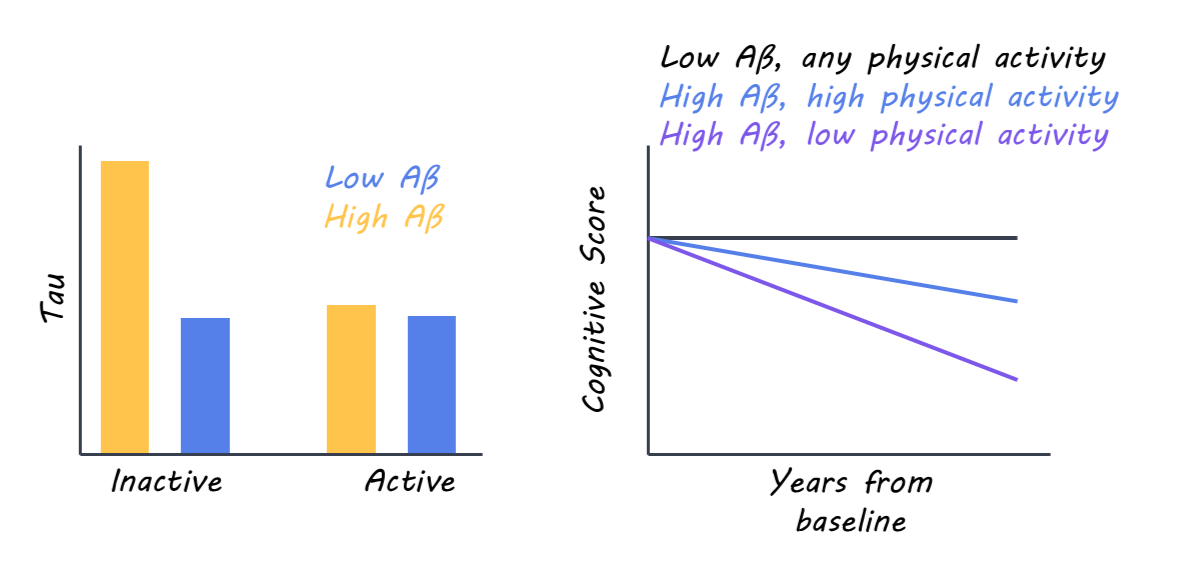
A 14-year-long study on the changes in cognition of older adults showed that for those at higher risk for cognitive decline (higher Aβ), a moderate level of activity (5,000+ steps) was associated with less cognitive decline. For these people, physical activity was linked to levels of the protein called tau in the brain, and this accounted for most of the changes in cognition.
What's the science?
Alzheimer’s disease and other dementias are an area of intense medical interest, especially now that people are living longer. There have been many studies establishing an association where greater exercise is linked to decreased cognitive decline (previous BrainPost on the subject here); however, these studies are just that—associations. There are a few elements that scientists can improve to better understand this link.
First of all, many studies are cross-sectional. That is, the data are gathered at a single point in time. So, while a cross-sectional study may sample people across different ages, they do not follow the same participants over time to see how their health evolves based on different factors. In contrast to this are longitudinal studies, which do follow participants over time, but these are relatively rare since they are more time and resource-intensive.
Second, variables like “exercise” and “memory” are often measured via a questionnaire, since this is more convenient. However, this can be problematic if respondents do not answer reliably, which is a concern when studying people with potential cognitive decline. More objective methods of measuring these variables exist: step counters are very common and can gather objective data about daily activity levels.
This week in Nature Medicine, Yau and colleagues reported the results of a longitudinal study (part of the Harvard Aging Brain Study or HABS), which included activity measured with step counters, cognitive testing, and brain imaging. They show the relationship between moderate physical activity and preserved cognitive function, along with a potential mediating mechanism in the brain.
How did they do it?
The study included 296 people from the HABS study who were cognitively unimpaired when they first signed up for the research. Participants were asked to wear a pedometer for a week near the beginning of their participation to measure their step counts. In addition, the authors selected participants who had undergone at least two rounds of cognitive testing (PACC5) as well as PET imaging at the time of the study.
PET (Positron Emission Tomography) is a neuroimaging technique used to identify different molecules in the brain with the help of a tiny amount of radioactive tracers. The researchers used PET imaging to measure levels of Aβ and tau, two proteins known to be involved in Alzheimer’s pathology. People with naturally high levels of Aβ are more at risk for cognitive decline, and the accumulation of tau proteins in the brain may be one part of that process of decline. The authors suspected that higher physical activity might be related to less accumulation of tau in the brain, which would in turn be associated with better cognition, but only for people with high Aβ (which puts them at higher risk). This kind of relationship is called a mediation.
What did they find?
Participants with low Aβ levels experienced less cognitive decline than those with high Aβ levels, and physical activity did not have much of an effect. However, for those with high Aβ, there was a significant effect of physical activity, with participants who logged more than 5,000 steps seeing the best results. Mediation analyses showed that for these people, cognitive decline was fully mediated by tau accumulation: that is, physical activity was related to less tau accumulation, and less tau was related to less cognitive decline. The activity didn’t have any further relationship with cognitive decline after accounting for the relationship with tau. The effect of activity plateaued after 5,000 steps, suggesting this is a good target for older adults to start increasing their step count.
What's the impact?
This study strengthens our confidence in the ability of exercise to stave off cognitive decline. Increasing step count is one way for older adults to improve physical activity and lower their risk of cognitive decline with aging. To further validate the effectiveness of exercise to combat aging, we need randomized controlled trials where people are assigned randomly to different levels of exercise and see whether the effect holds.