
How Diet Can Impact Memory Function
Post by Rebecca Glisson
The takeaway
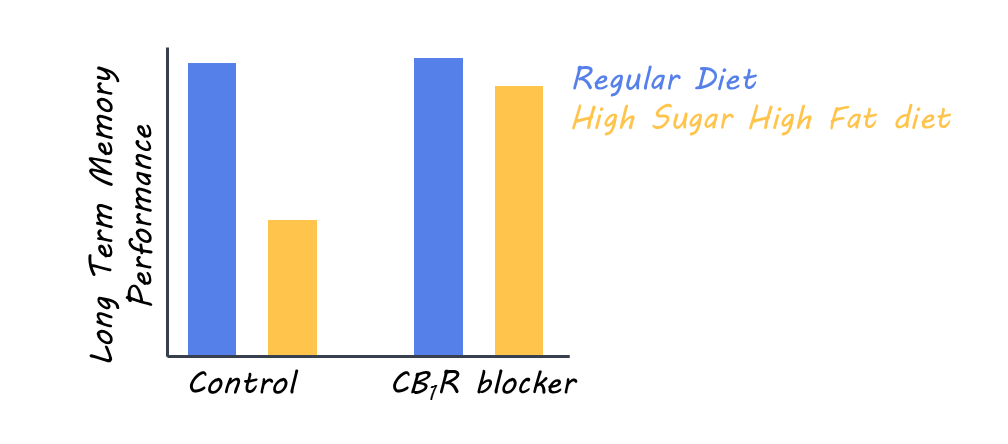
Diets that include excessive amounts of fat or sugar can impair our memory. Receptors in the hippocampus, an area of the brain that plays a key role in memory, can become overactive with a high-fat and sugar diet, and blocking these receptors can improve memory.
What's the science?
More and more often, scientists are uncovering how our diet is linked to brain function. For example, the endocannabinoid system of the brain, which includes type-1 cannabinoid receptors (CB1Rs), is known to be overactive in people with too much fat or sugar in their diets. This week in Current Biology, Ducourneau and colleagues investigated how a poor diet can lead to memory dysfunction via the endocannabinoid system.
How did they do it?
The authors wanted to study how diet impacts memory, particularly in adolescents, a critical period for the development of memory function. They gave juvenile male mice either a diet with high-fat and high-sugar or a normal diet, then had them perform an object recognition test to evaluate their memory. The test consisted of presenting a mouse with an object, then a delay of either 3 hours to test short-term memory or 24 hours to test long-term memory, then presenting the mouse with the same object and a new object. If the mouse remembered the original object, then they spent more time exploring the new object. Mice were then injected with a CB1R receptor antagonist, which blocks the activity of this receptor, and then tested again for their memory performance.
What did they find?
Mice with high-fat and sugar diets did worse on the 24-hour long-term object recognition test than control mice. Short-term memory performance, however, was not affected by diet, as measured via a test administered only 3 hours post-exposure. This suggests that poor diets have more of an impact on long-term memory function than short-term memory. When mice on the high-sugar, high-fat diet were injected with the CB1R activity blocker, they performed better on their memory test. This suggests that CB1R is responsible for memory issues when impacted by poor diets.
What's the impact?
This study is the first to show that diets high in sugar and fat lead to long-term memory impairment via the endocannabinoid system. Further, this memory impairment can be reversed by blocking cannabinoid receptors. A poor diet is especially harmful for memory development in adolescence.